Yes, you can retire before your partner if you have enough income and savings you can access to cover the years on one salary, with enough left to support you both once that salary stops. Before you hand in your notice, I’d also run the numbers on what would happen if your partner finished a couple of years earlier than planned. That can change how much you need from savings and whose super you can use.
In this episode of the Financial Autonomy podcast, Can You Retire Before Your Partner?: How to Make Two Different Retirement Plans Work, I talk about what happens when one of you is ready to finish and the other still enjoys work. We cover the money as well as what it feels like to be the first one to give up a salary.
How much will you need from savings while your partner works?
Imagine you’re 62 and ready to retire. Your partner is 55, takes home $65,000 a year and plans to work until 60. You expect to spend $80,000 a year as a household, so you’ll need $15,000 a year from savings while their salary is coming in. Over five years, that’s $75,000.
Now say your partner gets to 58 and decides they’re ready to finish too. You’ve had three years on one salary. For the next two years, neither of you is earning a wage. Here’s how that changes what you need to draw from savings or super.
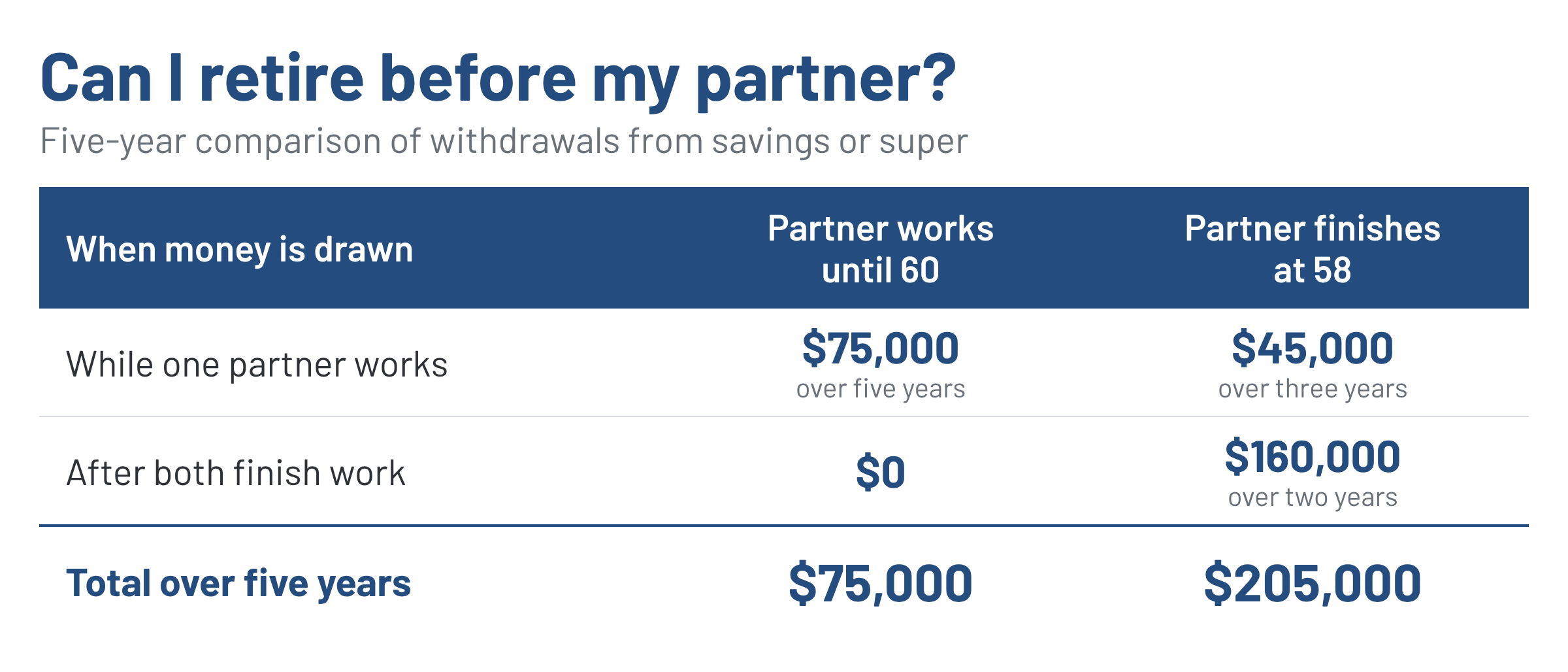
This example assumes steady spending and take-home pay, with no other income. It leaves out inflation and investment returns.
Your partner finishing two years earlier means drawing an extra $130,000 over the same period. I’d want to see what that does to the rest of the plan. Once you’re both retired, will you still have enough to cover your usual spending? Can you still take the trips you’d planned? At Guidance Financial Services, we can compare those scenarios and see how long your retirement savings could last.
Whose super can you use when one of you retires first?
In this example, the older partner can generally access their super when they retire at 62. If the younger partner finishes at 58, they generally won’t be able to access their own super until at least 60. For those two years, the couple would need to fund their spending from the older partner’s accessible super or money they hold outside super. You can check the ATO’s rules on when you can withdraw super.
If your partner still enjoys their job but would love Fridays off, going part-time before retirement is another option to put numbers around. How much extra would you need from savings each year, and would that change when either of you could afford to finish?
How will you handle spending when only one of you earns a salary?
You might both agree you can afford for one of you to retire, then find it feels different when it’s time to book a weekend away. If you’re the one who’s stopped earning, you might wonder whether the trip is a bit much. If you’re still working, you might feel more pressure to stay in the job because your pay covers most of the bills.
I’d talk through which bills will come out of the salary, what you’ll draw from savings and how much each of you feels comfortable spending on your own. It’s an easier conversation to have before either of you starts second-guessing a purchase.
If you’re sitting down together this weekend, start with three things:
Your retirement dates. When would each of you like to finish? How much earlier could that happen?
What you expect to spend. What does a normal year cost now? What changes when the first person retires, and what changes when you’re both retired?
The money available at each date. What income will still be coming in? Which savings or super could you draw on to cover the gap?
If you’re still working out what you want your retirement to look like, I’ve shared a few questions to ask before retiring. You can also work through our free Retirement Readiness Guide together.
Want to know if one of you can afford to retire first?
If one of you is ready to finish, we can use your numbers to compare what happens if you retire now, if one of you cuts back, or if your partner finishes earlier than planned. Our retirement planning advice can help you see how you’d cover the years on one salary and what you’d have left to live on once you’ve both retired.
Paul Benson is a retirement planning expert at Guidance Financial Services, helping Australians live the retirement they want. He hosts the Financial Autonomy podcast.
This article is for educational purposes only and does not take into account your individual circumstances. If you would like tailored advice, we can help you work through the numbers properly.